

Site Search
Search within product
第712号 2019(R1).07発行
Click here for PDF version
§積雪地域のナシ栽培における緩効性肥料入りBB肥料を用いた基肥・礼肥同時施肥技術の確立
Kyoto Prefectural Agriculture, Forestry and Fisheries Technology Center
Tango Agricultural Research Institute, Agriculture and Forestry Center
山口 俊春
§Improvement of Seed Protein Quality by "Wheat Fertilizer Daimyo," a Fertilizer with Controlled Fertilizer Effects on Wheat
Kumamoto Agricultural Research Center
Production Environment Laboratory
研究員 門田 健太郎
Incorporation of slow-release fertilizers in pear cultivation in snowy areas
BB肥料を用いた基肥・礼肥同時施肥技術の確立
Kyoto Prefectural Agriculture, Forestry and Fisheries Technology Center
Tango Agricultural Research Institute, Agriculture and Forestry Center
山口 俊春
Introduction
The Tango region, located in the northern part of Kyoto Prefecture, is the most active fruit tree cultivation area in Kyoto Prefecture, and the "Nijusseiki" pear variety is the main crop grown in the region, currently covering approximately 50 ha. In general, pears are fertilized three times: basal fertilizer (during the dormant season from November to December), additional fertilizer (during the growing season from April to August), and a post-harvest fertilizer (from September to October). Therefore, we conducted a test in order to reduce the amount of labor for fertilizer application and to secure working hours during the winter season by applying base fertilizer in the fall, which is the time for fertilizer reaping.
2. Testing Method
(1) Test outline
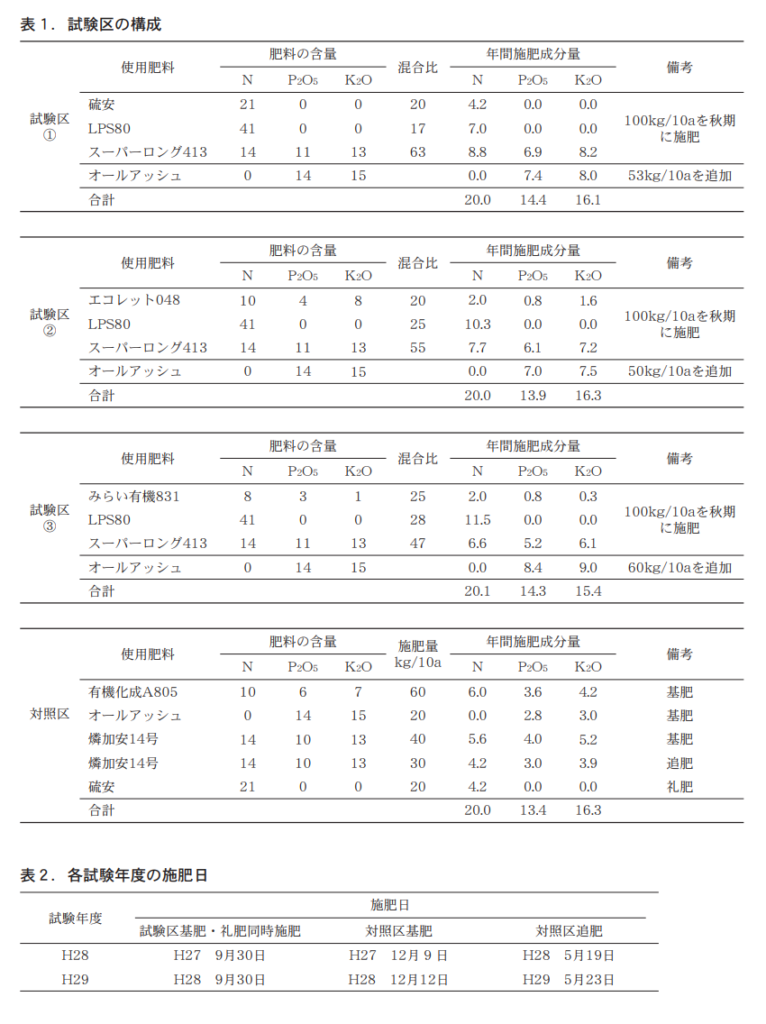
In order to reduce the labor required to apply fertilizer three times a year, we compared the growth, fruit quality, and soil fertilizer composition of pears under three different systems of simultaneous application of basal and retro-applied fertilizers and a conventional fertilizer application system using different combinations of BB fertilizers.
(2) Testing location:
丹後農業研究所内果樹園(細粒質褐色森林土)
(3) Prototype offerings:
Pear "Gold 20th Century" (20th grade as of 2009)
(4) Test fertilizer:
ammonium sulfate
Phosphate and potash compound fertilizer - All Ash
Coated Urea-LP Coat S80 (LPS80) (JCAM Agri)
被覆複合肥料−スーパーロング413 70タイプ(以下,スーパーロング413) (ジェイカムアグリ)
Mixed compost compound fertilizer - Ekolet 048(Asahi Kogyo)
Organic fertilizer - Mirai Organic 831 (castor oil cake) (Asahi Industries)
Organic Chemicals A805
(5) Composition of the test area:
The annual nitrogen application rate was 20.0 kg/10a, phosphoric acid was about 701 TP3T of nitrogen, and potassium was about 801 TP3T of potash. Each test plot consisted of two trees, with a planting interval of 4.5 m x 4.5 m and no repetition.
As shown in Table 2, fertilizer was applied in the test area at the same time as the control area (September-October), and basal fertilizer in the control area was applied in November-December. Additional fertilizer was applied from April to September, depending on the growth conditions. Tillage (soil mixing) was not conducted after fertilizer application. All-ash (0-14-15) was applied at the same time to keep the annual phosphoric acid and potassium inputs as low as possible.
(6) Survey Items and Methods
ア)土壌:秋期の施肥直前から定期的に土壌を採取し,硝酸態窒素(ジアゾ色素法),可給態リン酸(トルオーグ法),交換性加里(炎光光度法)濃度を測定した。
イ)生育状況:5月下旬〜8月下旬に果径,新梢長,果叢葉色(SPAD値)を調査した。
Fruit quality: In September, 100 pears were harvested from each area, and the average fruit weight, sugar content, fruit weight, and sugar content were examined for conformance to the Kyoto brand product "Kyo-Tango Pear" standard. The fruit was harvested once in FY 2008 and twice in FY 2009.
The standard for "Kyo Tango Pear," a brand-name product of Kyoto, is a superior product with a standard of L or higher and a Brix value of 11.5 degrees or higher as measured by a non-destructive sugar content sensor.
3. Summary of results
(1) Weather conditions
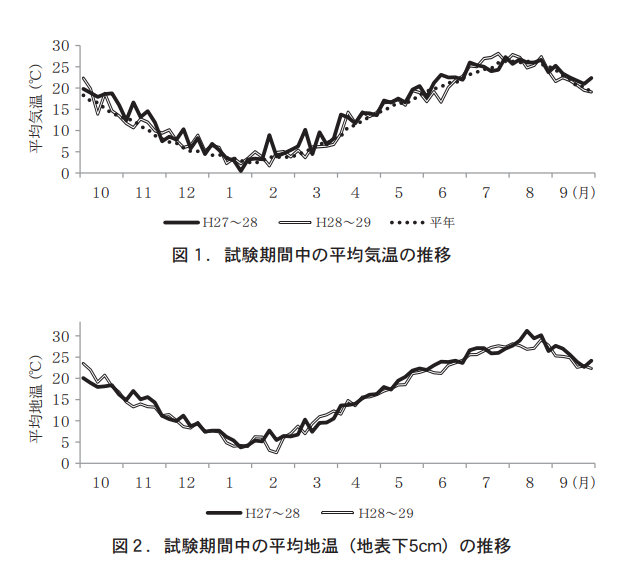
Comparing average temperatures, the winter of 2015-2018 was slightly warmer than normal and the winter of 2016-2019 was almost normal (Figure 1). Growing season temperatures were near normal for both cropping seasons. Differences in soil temperatures during the test period were smaller than temperatures (Figure 2).
(2) Soil chemistry
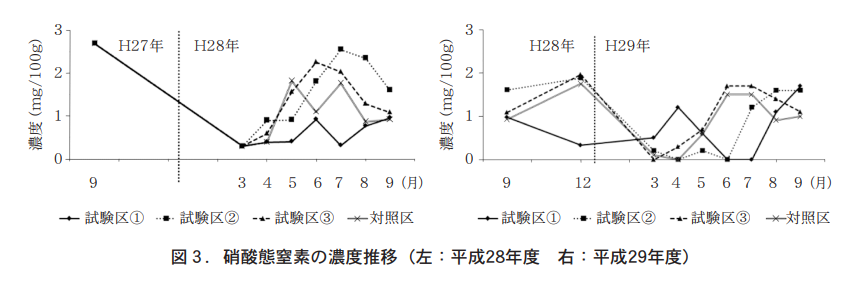
試験区①は,平成28年度は生育期間を通じて土壌中の硝酸態窒素濃度が他の試験区に比べ低く推移したが,平成29年度は基肥・礼肥同時施肥試験区では春期の硝酸態窒素濃度が最も高かった(図3) 。
また,28,29年度ともに可給態リン酸の濃度がやや低く推移したが,硝酸態窒素よりその差は小さかった(図4) 。交換性加里濃度は,基肥・礼肥同時施肥試験区間で大きな差はみられなかった(図5) 。
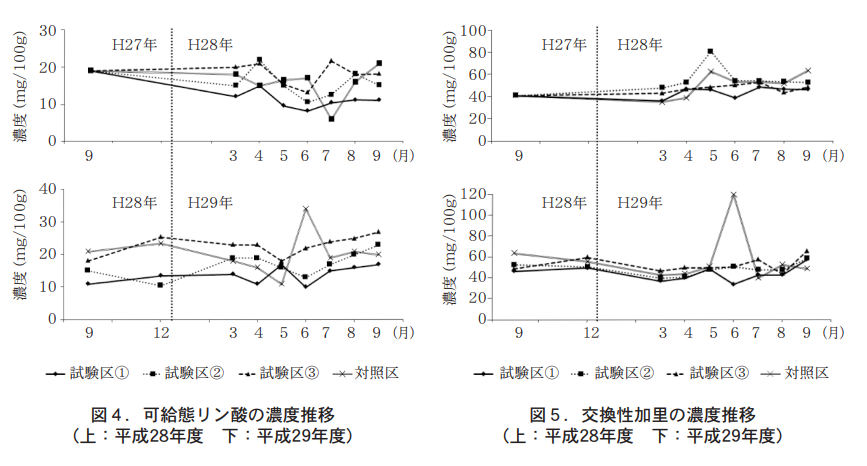
In test plots 2) and 3), the increase in nitrate-nitrogen concentrations during the growing season was slow and nitrate-nitrogen concentrations were high in the latter half of the growing season in both fiscal years 28 and 29 (Figure 3). Since the concentrations of ratable phosphate and exchangeable potassium did not increase during the same period, it appears that LPS80 was leached later than expected and was leached at this time of the year.
(3) Growth conditions
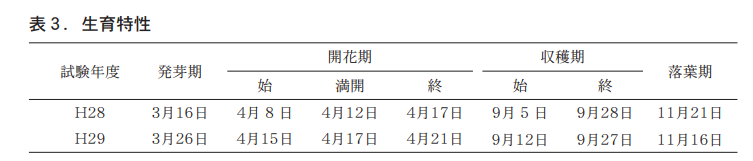
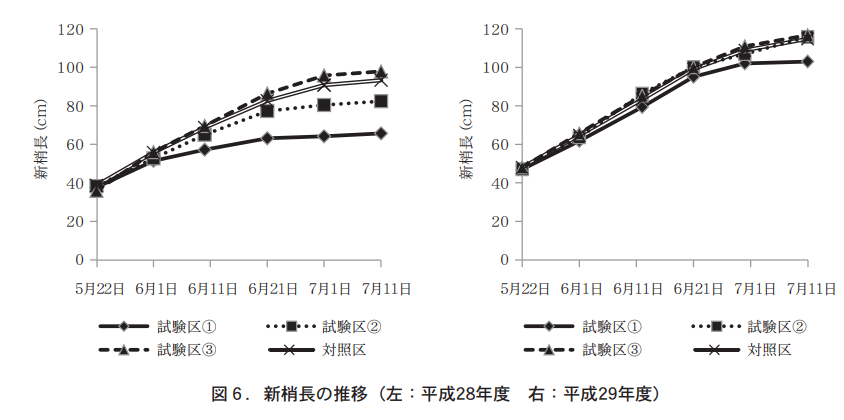
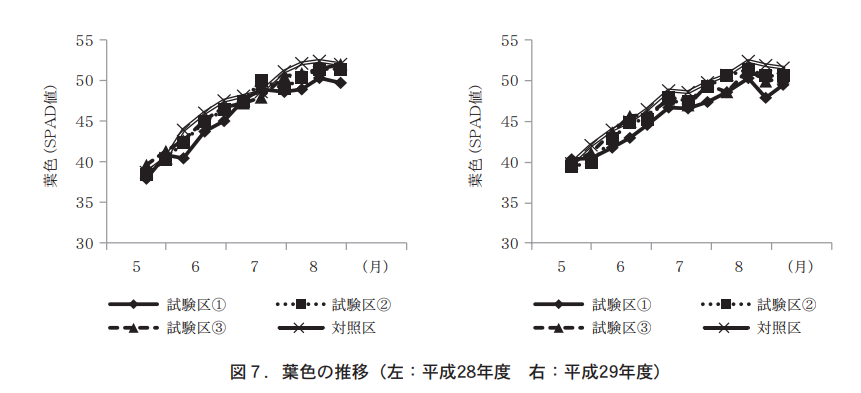
Growth characteristics data for each test year, such as germination date and full bloom date, are shown in Table 3. The fruit diameter growth curve, which indicates fruit enlargement, was almost the same in all test areas (data omitted). In test plot (1), shoot growth was slightly lower (Fig. 6). Overall shoot growth was better in the 29th year. In the control plot, the SPAD value of leaves after fertilizer application was slightly higher than in the test plot where the base fertilizer and courtesy fertilizer were applied at the same time (Figure 7).
(4) Fruit quality
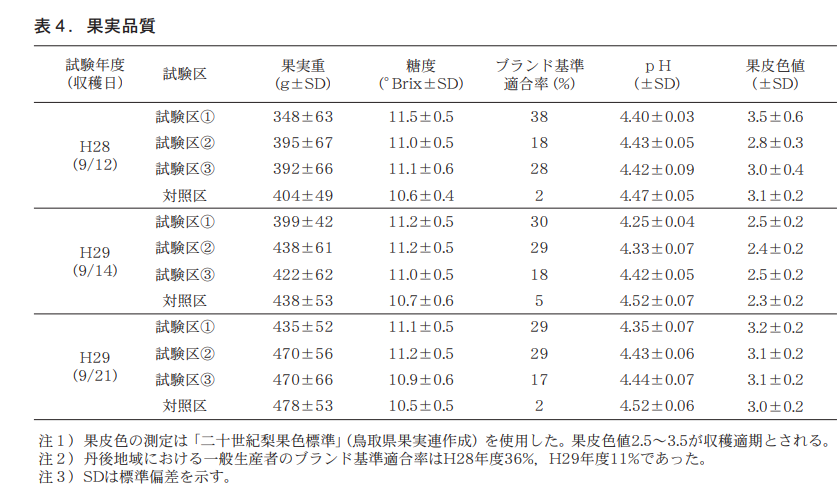
The fruit in test plot (1) were slightly smaller than those in the other plots (Table 4), but most of the fruit met the brand criteria for fruit size, and the fruit had the highest sugar content. Fruit weights in test zones (2) and (3) were similar to those in the control zone, producing large fruit and higher sugar content than in the control zone.
The percentage of fruit meeting the Kyotango pear brand standard tended to be test area (1) > test area (2) ≒ test area (3) > control area over the two-year period. The fruit weights of most of the fruits in all the zones met the brand standard, suggesting that the difference in fruit sugar content was reflected in the percentage of fruit meeting the standard.
Summary
A simultaneous application system of basal and reactive fertilizers was studied to save labor in fertilizer application to pears. The results showed that BB fertilizer, a combination of slow-release fertilizer LPS80, Superlong 413, and fast-release fertilizer ammonium sulfate, increased the nitrate nitrogen concentration in the soil faster and resulted in higher fruit sugar content and compliance with the "Kyo-Tango-Nashi" brand standard. Therefore, the simultaneous application system of base fertilizer and fertilizer with BB fertilizer is considered to be an effective labor-saving fertilization method for pears.
Fertilizer with controlled release for wheat
「麦追肥大名」による子実タンパク質向上
Kumamoto Agricultural Research Center
Production Environment Laboratory
研究員 門田 健太郎
Introduction
Kumamoto Prefecture's wheat crop for the 2009 harvest was about 14,200 tons, the 10th largest in Japan, with an area of about 4,880 ha. The wheat crop is planted under a paddy-wheat double cropping system, where paddy rice is grown mainly from June to October and wheat from November to May.
小麦栽培における施肥法は,1回の基肥と2回の追肥(1月下旬と2月下旬)の計3回の施肥を行う分施体系が慣行施肥法として採用されているが,小麦の国際的な価格競争などに備えるために規模拡大や生産コスト低減技術の導入が求められている。肥効調節型肥料は温度に反応して窒素の肥効がゆっくりと発現する特性があり,これを用いることによって施肥回数を削減することが可能である。
In this study, we examined the application effect of a newly developed fertilizer, "Daimyo," which is a fertilizer with a regulated effect exclusively used for wheat.
2. Testing Methods
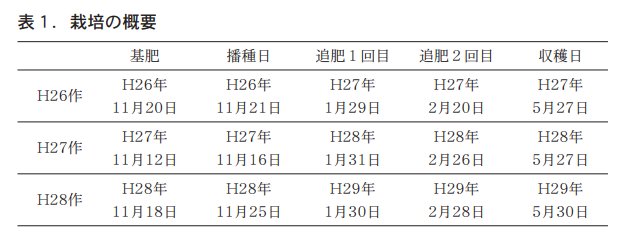
The trials were conducted in paddy fields (thick, humus-rich, humid black-bok soil) at the Kumamoto Prefectural Agricultural Research Center in Koshi City, Kumamoto Prefecture, using "Shirogane wheat," which accounts for about 401 TP3T of the wheat cropped area in the prefecture during the three-year period from 2014 to 2016 (Table 1).
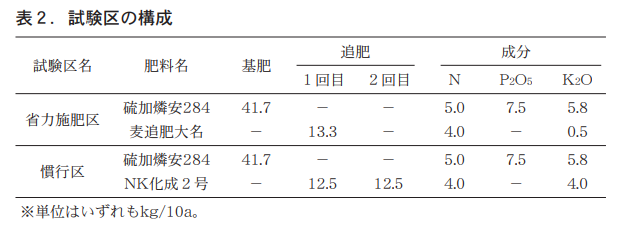
For the fertilizer test, a labor-saving fertilizer application area was set up in which one application of controlled-release fertilizer was used as a supplemental fertilizer, and a conventional area was set up in which two applications of fast-acting fertilizer were used as a supplemental fertilizer (Table 2). In the base fertilizer application, 28441.7 kg of phosphorus sulfide per 10 a of soil was applied to achieve a nitrogen content of 5.0 kg per 10 a in both test areas. In the labor-saving fertilizer application area, "Daimyo," a combination of fast-acting nitrogen 30% and slow-acting nitrogen 70%, was applied at 13.3 kg/10a (4.0 kg/10a of nitrogen component) in late January. On the other hand, NK Kasei No. 2 was applied to the conventional area at 12.5 kg/10a (2.0 kg/10a nitrogen component) twice, in late January and late February, respectively.
To determine the effect of this difference in fertilizer application on growth, the date of ear emergence, culm length, and ear length were investigated. Straw weight, seedling weight, thousand-grain weight, volumetric weight, and seedling protein content were also examined to determine their effects on yield, yield components, and quality.
3. test results
(1) Nitrogen leaching pattern of "Oats fertilizer Daimyo" during the growing season
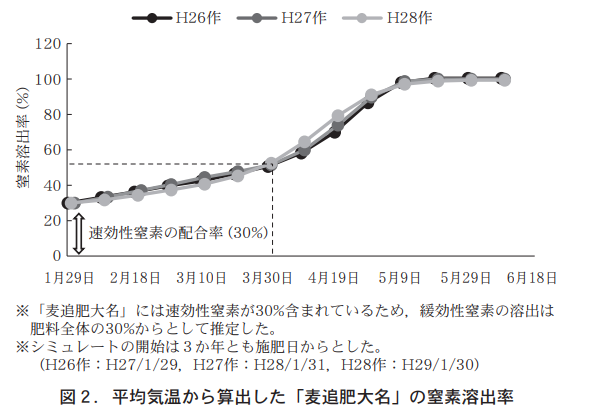
The average temperature during the growing season was 2°C or higher than normal twice in late January and early April for the H26 crop, four times in mid-February, early March, early April, and late May for the H27 crop, and twice in early January and mid-April for the H28 crop. The remaining period remained within ±2°C of the normal for all three years.
The leaching rate of nitrogen was simulated using the average temperature of AMeDAS weather data for the "Daimyo barley fertilizer" used in the labor-saving fertilizer application area (Figure 2). As a result, there was little difference in nitrogen leaching patterns among the three years, and it was estimated that about 2 kg/10a of nitrogen, including fast-acting nitrogen, was leached from late January to late March in all three years, and about 2 kg/10a of nitrogen was leached from early April to early May.
(2) Growth, yield and quality
There was no difference in the date of ear emergence between the labor-saving fertilizer- and conventional-applied areas in all three years. Comparing the growth of the labor-saving fertilizer-applied treatments at maturity with that of the conventional treatments, the culm length and ear length were shorter in the H27 crop, but there were no differences in other traits, and no effects of fertilizer application were observed (Table 3).
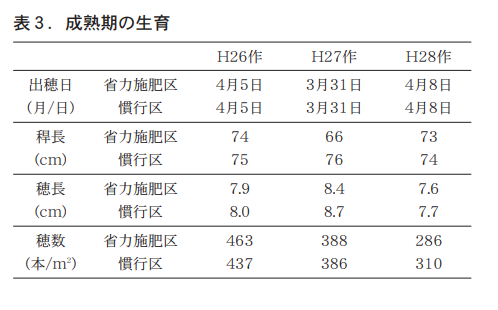
The number of ears varied from year to year, with the H26 crop having more ears in the labor-saving fertilization area, the H27 crop having no difference, and the H28 crop having more ears in the conventional area. Straw weight did not differ among the H26, H27, and H28 crops, and was lower in the labor-saving fertilizer-applied area.
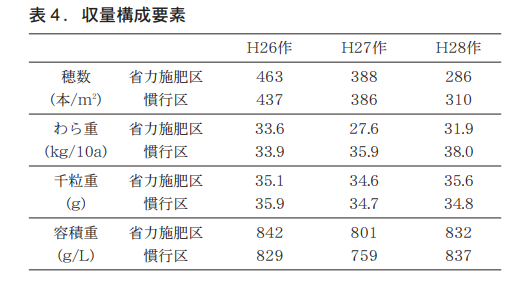
Comparing the yields of the labor-saving fertilizer treatments with those of the conventional treatments, there was no difference in seed weight in the H26 crop, but in the H27 and H28 crops, there was a tendency for the labor-saving fertilizer treatments to produce fewer seedlings (Fig. 3).
In terms of quality, the protein content of the seedlings tended to be higher in the labor-saving fertilizer application areas in all three years (Fig. 4). On the other hand, the thousand-grain weight did not differ among the three years, but the volumetric weight was slightly heavier in the labor-saving fertilizer-applied area in the H27 crop.
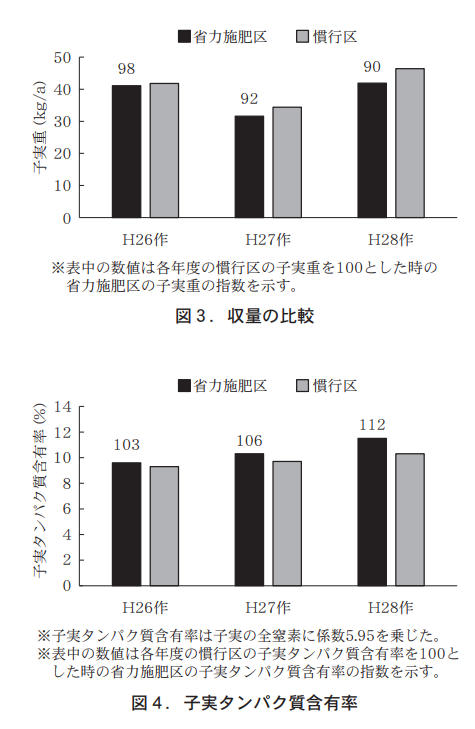
Based on the above, it was inferred that wheat cultivation with a single application of "Daimyo" wheat fertilizer tended to decrease seedling weight but increase seedling protein content compared to the conventional two applications of fertilizer.
Discussion and Summary
The effect of the application of "Daimyo," a fertilizer developed exclusively for wheat as a supplementary fertilizer, was studied over a three-year period.
The results showed that the labor-saving fertilizer application system with one additional fertilizer application using "Wheat Fertilizer Daimyo" reduced yields by 2-101 TP3 T, but tended to increase seedling protein content in terms of quality compared to the conventional system with two additional fertilizer applications using a fast-acting fertilizer.
The reason for the lower seedling yield compared to the conventional fertilizer may be due to the insufficient nitrogen supply from late January to March, when the crop is in full leaf. The nitrogen supply from "Daimyo barley fertilizer" is estimated by the nitrogen leaching simulation to be about 0.8 kg/10a from the time of fertilizer application to late March, when ear emergence begins, while the total nitrogen supply from late January to late February is 4.0 kg/10a under the conventional partial fertilizer system. This difference probably led to a decrease in the number of offshoots, and furthermore, to a decrease in yield.
In contrast, it is noteworthy that fertilization with "Barley Fertilizer Daimyo" increased the nitrogen content of the seedlings and the protein content of the seedlings regardless of the year. This effect on quality is in good agreement with the results of nitrogen leaching simulation, which showed that about 2.0 kg/10a of nitrogen is leached out from the ear stage. In the field test using "Wheat Fertilizer Mei" on the bread wheat variety "Minami no Kaori," the yield of seedlings varied depending on the region and year of the test, but in all cases, the protein content of the seedlings was improved.
These results suggest that the application of "Wheat Fertilizer Daimyo" to wheat is effective in improving quality by increasing the protein content of the seedlings and saving labor by reducing the frequency of fertilizer application. However, since the yield may be lower than that of conventional cultivation, further study is needed on the elution type of coated urea and the ratio of fast-acting nitrogen to slow-acting nitrogen.